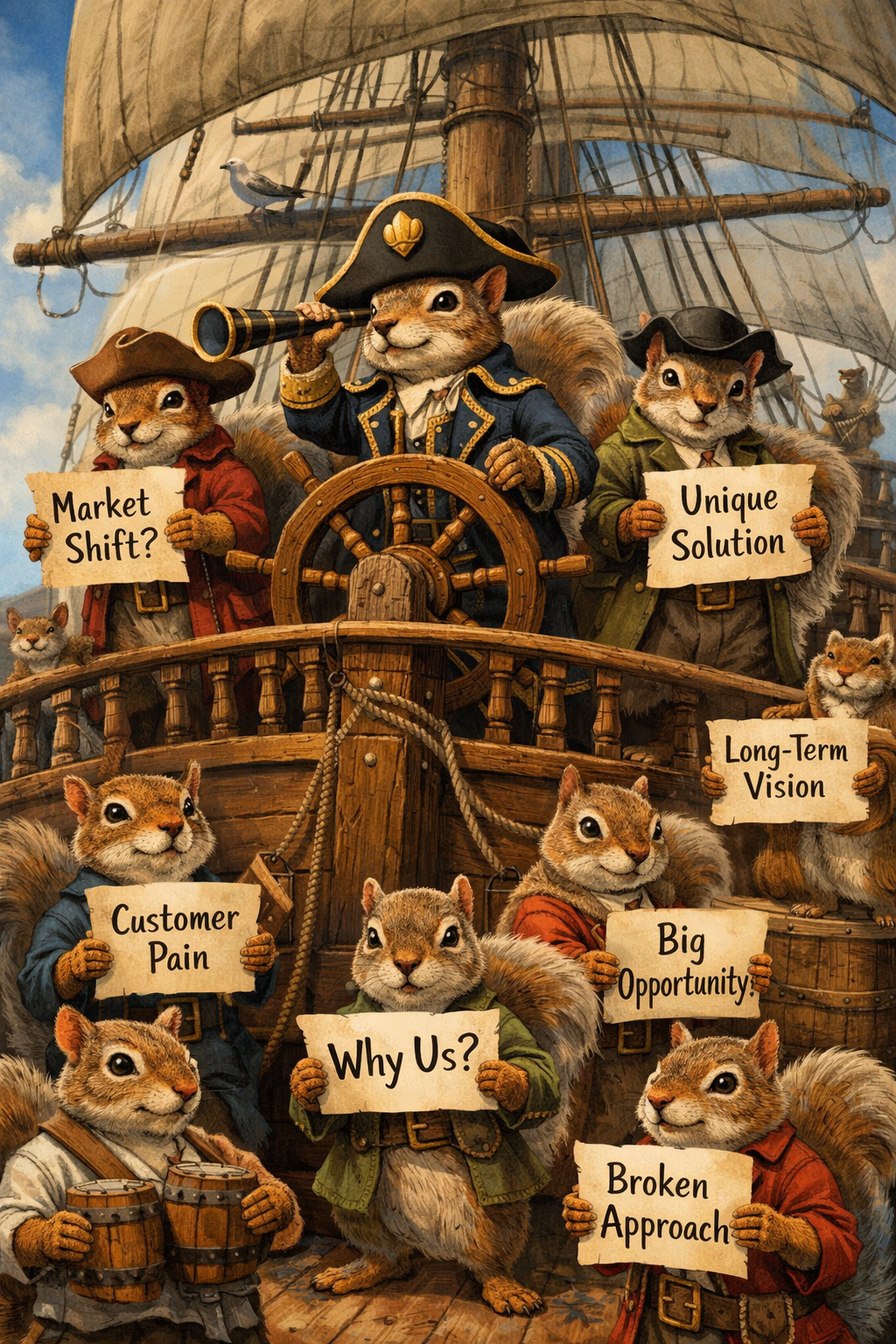
Using AI to Scale Positioning Without Diluting It
How to build a simple agent that generates content inside your positioning guardrails and stress tests every asset before it goes live

Most teams are using AI like a caffeinated intern. You hand it a prompt, and it hands you back a headline, five taglines, a value proposition, a LinkedIn post, and possibly a manifesto if you let it run long enough. It’s fast and impressive, but the results can be slightly unhinged because speed is not the same thing as strategy.
When AI is used only as a rapid content generator, the output often sounds polished yet strangely interchangeable. The language is clean, the structure is sound, and the benefits appear reasonable, but if you removed the logo, it could just as easily belong to a competitor. The issue is not that the model lacks intelligence; the issue is that it lacks context unless you deliberately give it one. Positioning is that context. Without it, AI produces competent language. With it, AI can produce coherent strategy-driven content at scale.
If we stay focused on content creation, the practical shift is to stop prompting in isolation and start building a simple agent around your positioning. The positioning brief becomes a structured input into the system rather than a document that lives in a shared drive and slowly gathers dust. That brief should clearly define who you serve, the problem you solve, the differentiated outcome you enable, the evidence that supports your claim, and the tone and boundaries that shape how you speak. It does not need to be poetic; it needs to be precise enough that a system can reference it.
Once that brief exists, the AI workflow changes. Instead of asking for a homepage draft with no guardrails, you instruct the agent to generate content using the positioning brief as a primary constraint. The agent references the defined customer profile, the core problem statement, and the specific differentiators while drafting. Then, in the same workflow, it evaluates its own output against those inputs. It checks whether the differentiation is actually visible in the language, whether the tone aligns with the intended audience maturity, and whether any claims drift into generic category phrasing that weakens your distinct position.
This dual process, generate and then immediately test against the brief, creates internal discipline. Rather than relying on memory or subjective judgment to enforce alignment, you build that alignment into the production system itself. Over time, this reduces the subtle drift that happens when campaigns evolve independently of the original strategy. Each new asset is shaped by the same core narrative, which means the brand signal remains consistent even as output volume increases.
The same logic can extend to visuals. If your positioning communicates analytical rigor and long-term credibility, the imagery associated with your brand should reinforce those signals. By defining visual parameters within the brief and training the agent on examples of aligned and misaligned creative, you can incorporate visual evaluation into the workflow. The system can flag when a concept leans on overused industry tropes or when stylistic choices contradict the maturity level you are trying to convey. The goal is not to automate taste but to ensure that content and visuals consistently reflect the same strategic core.
What makes this approach work is its structure. AI is extraordinarily capable at producing language quickly. When that capability is anchored to a clearly defined positioning brief and wrapped in an agent that both generates and evaluates content, speed and coherence can coexist. The caffeinated intern still drafts, but now it drafts within defined boundaries and immediately checks its work against the strategy that guides the business.
In an environment where AI has lowered the cost of producing content, the real differentiator becomes the quality of the inputs and the discipline of the system. Teams that embed their positioning directly into an agentic content workflow can move quickly without diluting their message. Instead of scaling generic language, they scale clarity, reinforcing the same differentiated narrative every time a new asset is created.
Build the agent
- Formalize the positioning brief
Write the positioning brief in a structured format rather than prose alone. Include sections for ideal customer profile, core problem, differentiated outcome, proof points, tone constraints, visual principles, and explicit language exclusions. Clarity at this stage determines the quality of everything that follows. - Translate the brief into system instructions
Load the brief into your AI platform as a persistent system prompt, knowledge file, or reference document. The key is that the agent always sees this brief before generating content and treats it as a governing document rather than optional context. - Separate generation from evaluation
Design a two step workflow. In step one, the agent generates the requested asset using the positioning brief as a required constraint. In step two, the agent evaluates that draft against predefined criteria such as differentiation strength, clarity of problem statement, tone alignment, and avoidance of generic claims. The evaluation should be explicit and structured. - Define evaluation criteria in advance
Create a scoring or feedback rubric that reflects your positioning priorities. For example, require that differentiation be visible in the first section of a homepage draft or that every major claim be supported by a proof point. This prevents subjective revisions and anchors feedback to strategy. - Apply the same structure to visuals
Document visual guardrails in the positioning brief. Provide examples of aligned and misaligned creative. Ask the agent to describe how a proposed visual concept reinforces or contradicts stated brand attributes before approving it. - Iterate and refine
As you review outputs, adjust the brief and the evaluation rubric. If you notice recurring drift into certain clichés or tone shifts, codify those lessons into the agent’s instructions. Over time, the system becomes more precise because it reflects real-world learning.
This is not about replacing human judgment. It is about embedding your positioning into the machinery of content creation so that every draft, whether written in minutes or hours, reinforces the same strategic foundation.
If your AI output feels polished but indistinguishable, it may not be a writing problem. It may be a positioning problem. Let’s define the brief your content actually needs. Set up a call
Ali on Marketing